Showing posts with label 1970s. Show all posts

Saturday, 7 April 2012

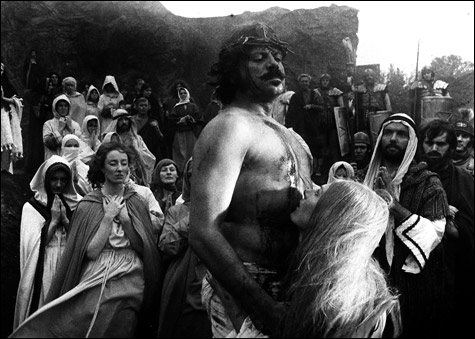
The Devils (1971)

Directed by Ken Russell
Written by Ken Russell, John Whiting, Aldous Huxley (novel)
Starring Oliver Reed, Vanessa Redgrave, Dudley Sutton


How do you make a deeply and angrily political film, using a broadly true story of a sex-and-demons scandal in seventeenth century France, with enough power to strongly influence viewers, and still persuade a major studio to support it all the way?  Well, perhaps you don't.  Certainly, if you're making it in 1971, you're going to have a spot of bother - which is why the BFI's new dvd release of The Devils is, after four decades, the closest we're likely to get to the film that the late Ken Russell wanted us to see.

It goes without saying that the loss for so long of the film in an unbutchered form is a great shame, not just because it's a hugely powerful and expressive picture - it is - but because the movie has so much to say, all of which was buried beneath the controversy for many years.  And it's worth addressing this controversy, the extremity of the movie:  yes, it's a difficult watch, confusing and aggressive and - by the standards of the early 1970s, although not today, not in our much-changed world - decidedly graphic.  Extremity for a reason, though, bombarding the viewer, confusing and grabbing the viewer, to give all the more impact to the message.

The message is important, too.  Very important, in 1971 as in 2012.  The movie tells of the very real 'craze' for identifying witchcraft and demonic possession across Europe at the height of the counter-reformation, and the exploitation of this mass panic and - for want of a better word - witchhunt to empower Cardinal Richelieu and the French regime.  Set in Loudun, a wealthy and rebellious city, resisting central rule but protected behind vast and unbreachable walls, we see the henchmen of Richelieu creating an uproar, a desperate and insane fear of demons, to bring down the leader of the city, and the city's defences with him.  Those henchmen, and Richelieu himself, are surrounded by odd hints of modernity - twentieth century glasses, steel chairs, a headquarters laid out like a prison of today - and we can discern in them a reflection of authority in the director's own time.  Where fear and desperation and ignorance are exploited to control the masses, we see a panic motivated by tales of demonic possession - but we can also see, between the lines, a panic motivated by tales of reds under the bed, Communist infiltration, unAmerican activities.

Can we not also see, in 2012, just the same fear of 'terrorism'?  Can we not also see governments preying on the scared and ignorant, claiming to drive out evil forces that move among us, but acting only to take away our rights and our liberties? As Oliver Reed's wrongfully accused priest cries
Look at your city! If your city is destroyed, your freedom is destroyed also... If you would remain free men, fight. Fight them or become their slaves!
while the people of the city, screaming and demented, stare at his execution and not at the walls coming down behind them, so any one of us could turn and see the ramparts of our rights being pulled apart, if only we could draw our eyes away from the witchhunts and the madness being played out for our amusement.

In a week that has seen the British government propose ever deeper attacks on our freedom in the name of 'defeating terrorism and organised crime', the fullest ever release of The Devils couldn't be more timely.


Tuesday, 3 January 2012

The Eagle Has Landed (1976)

Michael Caine, as the Cockney German.
Directed by John Sturges
Written by Thomas F. Mankiewicz, Jack Higgins (novel)
Starring Michael Caine, Donald Sutherland, Robert Duvall, Jenny Agutter, Donald Pleasence, Larry Hagman


Somewhere in Hollywood, perhaps in a bunker midway between all the major studios, there’s a conveyor belt.  It’s just like the conveyor belts you get in airports, the big loop, people waiting for what they need to come around, and with a long, mysterious section hidden from the view.  It takes a fair while to make a complete circuit, perhaps twenty years or so, but it never stops entirely.  And on this conveyor, they place boxes full of used-up genres and plotlines, send them off into that strange world behind the curtain, and wait excitedly for another box to come out the other end, full of old ideas to put back into service.

Yet, hidden behind that curtain, there seems to be a box that’s fallen off.  How better to explain why there’s been no resurrection for a hugely popular strain of movies that came out between the late 60s and the mid-70s?  Big, grandiose pictures, with an all-star cast, striking, Technicolor vistas and usually a plot slightly thinner than the tub the popcorn came in.  For the most part, they were either about disasters (think The Towering Inferno, The Poseidon Adventure or the Airport films), or about the Second World War (The Great Escape, The Dirty Dozen, The Guns of Navarone), were full of big set pieces and explosions, and nowadays they mostly turn up on television to fill a bank holiday afternoon.  And good fun they are too, good, stupid fun – but they’re preserved in aspic, a leftover of a last burst from the old star-centric studio system, never again to be repeated.

It’s certainly hard to imagine The Eagle Has Landed being made today.  The explosions would still be there – probably a lot more of them, probably directed by Michael Bay or Gore Verbinski, certainly full of CGI – but the all-star cast would be gone, as would the Boy’s Own adventure story.  It just wouldn’t be as charmingly daft.  It certainly wouldn’t be anything you’d see on a bank holiday afternoon.  Why (apart from the box falling off the conveyor)?  Well, for one thing, the studios know now that, thanks to dvd, tv and online aftersales, whatever film they put out isn’t going to lose any money, so there’s no point roping in quite so many names; for another, Hollywood productions have become far too focus-group and market driven to allow for such cheery silliness.  That’s not to say there’s no longer any stupidity in Hollywood pictures – there’s more than ever, if anything – but that it’s cynical, ugly, stupidity, a dumbed-down ugliness that stems from the new economics of the cinema.

I’d far rather watch a film which wears its over-the-top absurdity on its sleeve.  Here we not only have that bigger-is-better cast, but they’re all turning up in a wonderful variety of different accents – Robert Duvall doing standard movie German, Michael Caine doing, um, Cockney German, Donald Pleasance doing Donald Pleasence, Donald Sutherland doing comedy Oirish – and enthusiastically hamming their scenery-chewing way through a dashing tale of derring-do (which is, as it happens, lifted almost wholesale from Cavalcanti’s superb wartime propaganda film, Went the Day Well).  And what we don’t have is, by any sensible standard, a classic, a great movie, a significant contribution to the art.  It is, after all, idiotic tosh.  But, hey, so what?  It’s fun.  Particularly on a bank holiday afternoon.

Saturday, 5 November 2011

Apocalypse Now Redux (2001)

Dennis Hopper in a very nice picture.  I've not mentioned him at all.
Written by Francis Ford Coppola, John Milius, Michael Herr, Joseph Conrad (novel)


I’m not going to bother writing much about Apocalypse Now. For the most part, this is because I assume – and I think it’s fair to assume – that nearly everyone who’s likely to see it has done so, has formed clear opinions about it, has read or heard or talked about it. Like Citizen Kane, or Star Wars, or Casablanca, it’s one of those films that’s gained such prominence over the years that there’s really nothing left to say. 
 
But there’s another reason for not really writing about Apocalypse Now. It’s because I’ve not really seen it for a few years. Not how it ought to be seen. What I have watched rather more recently is Apocalypse Now Redux – yes, that’s Redux, not Director’s Cut. The difference is apparently important. According to Wikipedia,  
Redux is usually considered by fans and critics, as well as director Francis Ford Coppola, a completely new movie altogether.
Now, when I got to see a completely new movie, I’d normally hope that it wouldn’t contain two-and-a-half hours of an existing movie, and a classic at that, but let’s not split hairs. Coppola wants us to know that this isn’t a director’s cut, but rather the cut that he, the director, would like the world to see. As I said, it’s an important difference. Apparently. And I certainly wouldn’t suggest for one moment that Coppola wants to be seen as doing something more artistically and cinematically significant than other directors. Not that kind of guy at all. Not the kind of director who would see himself as a step above everyone else, the kind of director who wouldn’t allow anyone to see Abel Gance’s Napoleon unless they watch his own edit with his father’s score, rather than the way Gance wanted it to be seen. What? Oh, right. 
 
Anyway, I digress.

Twenty-odd years before the Redux, Coppola and editor Walter Murch felt able to discard the material that surfaced in the Completely New Movie version.  As is normally the case with director’s cuts – not that this is a director’s cut, of course – there are a few scenes that are a little more bloated than they originally were, a minute here, thirty seconds there, short clips of footage trimmed for good reason and now restored because the director likes them. But it’s the two long scenes that have been added that really mark the difference between the Redux and the original cut, and which account for most of the extra fifty minutes that the new version runs for; the first of these is an odd detour into farcical sex-comedy, as the men pay for shambling, hurried sex with the Playboy bunnies they’d met earlier; the second has the boat stop off at French plantation, bury Clean, and have a chinwag over dinner.    

Two long scenes that Coppola and Murch once felt able to discard. What changed? What is it about a clumsy scene of small-scale prostitution or a dull diversion with a few Frenchmen that had no place in a superb movie of 1979 but are now deemed absolutely necessary in the twenty-first century? Well, the former is inescapably 70s, seemingly escaped from a sexploitation flick, so quite how that contributes to making a Completely New Movie for today, I’m not certain. And the latter, although it briefly threatens relevance with the opportunity to pay respect to the death of such a young man, is mostly concerned with eating up time whilst achieving nothing in particular – the kind of dull, misguided scene that ends up on the cutting room floor when an awful lot of films come to be edited.
 
And that, really, is my point. I know it’s taken an awfully long time to get here – I need to be edited a bit more – but there it is, the point of all this rambling. Those two scenes weren’t cut at random, they were cut for a bloody good reason: that their absence makes for a better film. And that’s true of a good ninety per cent of all new cuts, be they director’s cuts or whatever; once in a while, a film (such as Ridley Scott’s Blade Runner or Orson Welles’ Touch of Evil) will be torn apart in editing, with much of what’s good about the picture taken away – but only very rarely. Mistakes happen in all walks of life, bad decisions are made, and it should never be assumed that the director knows best how the finished movie should appear. He usually doesn’t. That’s why editors exist. That’s why a good editor can make so much difference to a film.
Steven Spielberg, when editing Jaws with Verna Fields, didn’t want to lose a second of shark footage, largely because he’d spent months trying to get that damn rubber fish to work and hoped to make the most of it. Fields, thankfully, put her foot down, and the director recognises today that Jaws became the film it was largely because there’s so little of the shark and so much of the men. 
 
On the other hand, Richard Kelly clearly didn’t recognise the work put in by editors Sam Bauer and Eric Strand when it came to Donnie Darko. The m0vie that made it to the cinemas was ingenious, enigmatic, energetic, thought-provoking and thoroughly good fun – an outstanding 80s teen movie with a just-confusing-enough sci-fi story stirred in, and one of the most striking and acclaimed films of the decade. However, the release of the director’s cut showed us that Kelly was after something entirely different, a long, daft story in which every fantasy detail was explained in the clearest and least interesting terms possible. That godawful mess was Kelly’s baby, and he must have been horrified to see the editors cut it into something brisk, entertaining and, well, good.  

Given how much he put into it – financially, physically, emotionally – it’s easy to see how every second of footage recorded for Apocalypse Now would be Coppola’s baby. And easy to see how much of an itch it must have been for him, knowing for two decades that two substantial scenes of his work, his creation, remain abandoned and unseen. I hope he’s happier now that fifty minutes is out there for the public to see – but that’s no reason for the rest of us to be interested. The 1979 original was wonderfully edited, and a magnificent piece of cinema. Watch that. Don’t indulge Coppola. He’s had more than enough indulgence as it is.


Thursday, 3 November 2011

The Boys From Brazil (1978)

Gregory Peck, auditioning for a role as a Bond villain.
Directed by Franklin J. Schaffner 
Written by Ira Levin, Heywood Gould
Starring Gregory Peck, Laurence Olivier, James Mason, Lilli Palmer, Denholm Elliott, Bruno Ganz


Do you remember Josef Mengele? Well, not personally (I’m assuming), but you’ve heard the name, yes? Mengele – as you’re no doubt aware – was a genuinely twisted and repugnant monster, even by the standards of a century packed with them. He was responsible for the torture and murder of hundreds of individuals, mostly twins, in the name of a warped and horrific view of medical science. His sadistic and brutal experiments to satiate a curiosity about humanity and to attempt to prove theories that were glaringly wrong constitute a crime almost without compare in human history.

All of which makes it rather surprising to find a different Josef Mengele in The Boys From Brazil. This Mengele did commit the same monstrosities – we know this, it’s mentioned briefly, and we see a couple of people who’ve been experimented on (they have suddenly blue eyes) to prove it – but that’s barely relevant. See, it turns out that Mengele was not so much a vicious and deranged sadist as a camp 60s supervillain that even Ian Fleming would have considered a little too over-the-top. 
 
We find this Nazi Blofeld (Gregory Peck, unexpectedly) in Paraguayan exile, the final brush both with actual history* and common sense. Clearly, he must be caught, and it falls to elderly Nazi-hunter Ezra Liebermann (Laurence Olivier, in a role inspired by Simon Wiesenthal) to catch him. Why? Is it enough to try to catch Mengele because he deserves to be brought to justice? No, of course not. Mengele needs to be caught because he’s planning to take over the world with his secret army of Hitler clones. Obviously.

(The Hitler clones, for what it’s worth, all have dark hair, pale skin and… blue eyes. Presumably because everyone knows Hitler was obsessed with blue eyes, and regardless of the rather glaring fact that Hitler had brown eyes, and any clone of him would be the same. Even allowing for the relative lack of genetic knowledge in the 1970s as opposed to today, it would still have been reasonable to assume that genes trump ideology every time when it comes to reproduction. Nonetheless, we know they’re all Hitler clones, because they’re a bit grumpy and selfish and have severe partings in their hair.)

The bones of the story could easily have been turned into a comedy-scifi-thriller, with an entirely fictional cast of characters. Might have been a bit of good fun, too, particularly if it lost the embarrassing fight scene between the two elderly leads. Today, it might have a cult following and a high standing amongst comedy thrillers of the time. But no. 
 
Alternatively, the fine cast could have been put to better use in a serious thriller about the actual pursuit of Nazi war criminals in Latin America, and the courageous and devoted work of those who dedicated their lives in the hope of finally achieving justice. But no.

No, what we have is a daft, hole-ridden plot, polished by some picturesque locations and that exemplary cast. And we have something else: we have a torturer and murderer turned into an absurd villain in an adventure story. Perhaps I’m oversensitive, but I find such a lack of respect and decency towards all those who suffered and died in horrendous circumstances at Mengele’s hands to be insulting and deeply offensive.

This is a horrible film: horrible, stupid, and all the worse for that stupidity. 


*I accept, of course, that at no point did the movie claim to be anything other than fiction. I raise this issue purely because of the highly significant and unpleasant historical nature of the real Mengele and the decision to use him as a character in a daft thriller.